


What we’ve shipped: H1 2026 product releases
Updated: July 2026
The questions operators need to answer don’t wait for a convenient moment. A site underperforming on a Tuesday shouldn’t still be a mystery on Friday. A menu change needed before the breakfast rush shouldn’t require a support ticket. And if the internet goes down, orders should still reach the kitchen.
Over the first half of 2026, we’ve shipped features built around three goals: new ways to drive revenue, greater efficiency running the estate, and more peace of mind that your systems will hold up when it matters.
Here’s what’s now available across the Vita Mojo Restaurant Order Management System.
Drive revenue
Scout: the AI analyst that already knows your operation
Before Scout, getting a meaningful answer from your operational data meant manually pulling reports, briefing an analyst, or skipping the analysis altogether.
Most questions just stayed unanswered.
Scout is Vita Mojo’s AI analyst, embedded directly in VM Hub. It already knows your entire operation across all sites, channels, and time periods. Ask a question in plain language and get an answer you can act on. No setup, no data exports, no context required.
What makes Scout different from other AI tools is that it shows how it’s thinking about the problem. Most AI tools give you a confident-sounding answer with no explanation of how they got there. If the answer is wrong, you won’t know until you’ve acted on it. Scout shows exactly how it reached every answer, so your team can interrogate it, trust it, and act with conviction.
One example from the pilot: analysing which sites actually make money in their last trading hour, rather than assuming everywhere should stay open until close because that’s how it’s always been done. Operators who ran that question reshaped their trading hours around data rather than habit.
Scout is available as an add-on to your VM Hub subscription. Learn more about Scout, the AI analyst for QSR.
Loyalty now connects with Deliveroo and Uber Eats
Guests ordering through third-party delivery platforms can now earn loyalty rewards on those orders, too. Operators can drive guest engagement and attract more customers to direct ordering over time.
Increase efficiency
VM Hub: full self-serve control of your estate
On 18 May, we retired Management Panels 1 and 2. VM Hub is now the single place to manage your estate and understand performance through analytics and Scout.
That shift matters in practice. Operators can update settings on their own schedule, without raising a ticket and waiting for a reply. Changes can be scheduled in advance, so there’s no need to wait until after trading hours. History and restore mean a mistake can be rolled back quickly, without involving support.
If a setting previously needed a ticket to change, it now takes seconds.

KMS driver status
Kitchen Management System (KMS) users can now see driver status directly, helping ensure deliveries are picked up on time and reducing the back-and-forth between the kitchen and front-of-house during a busy service.
Peace of mind
Offline capability for POS and KMS
This is the one that matters when everything else goes wrong.
POS and KMS now communicate directly over the local network. If your internet goes down, orders still get placed, sent to the kitchen, and bumped automatically. No manual reconciliation. No lost orders. No phone calls to the support desk mid-service.
For operators running high-footfall sites where downtime has a direct cost, this reliability update removes the single biggest point of failure.
Kiosk observability
We’ve added tap-to-load speed tracking at the kiosk, store, and brand level. Performance issues can now be spotted and resolved faster, before they affect the guest experience or slow down service during peak periods.
What else shipped?
A number of smaller improvements have also gone live:
- Regulatory compliance updates for the unit of measurement
- Internal tooling improvements that help our team resolve support tickets and complete implementations faster
- Online store code rebuilt from the ground up, so future development is faster and more reliable
What’s coming in H2 2026
Smart Menu: your menu, working harder
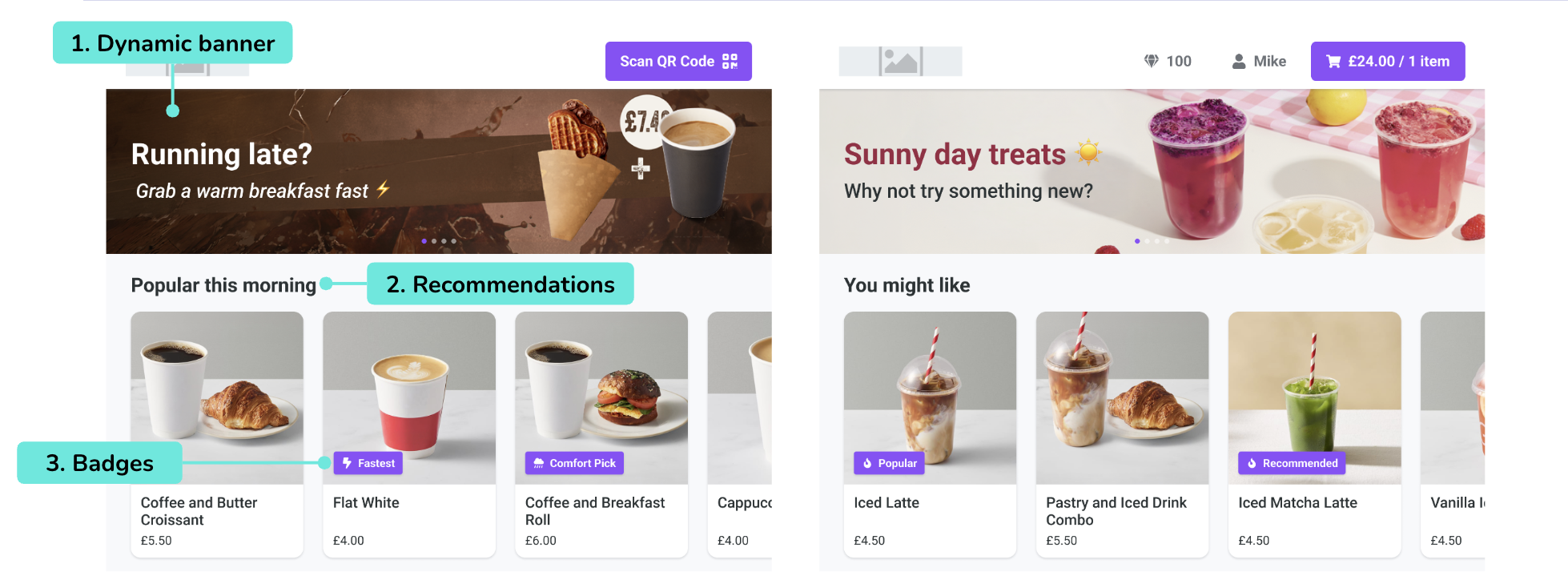
Smart Menu is the next major investment in AI at Vita Mojo, following Scout. Today, every guest sees the same menu regardless of the weather, the time of day, or where they are. Smart Menu changes that.
More control, less admin
Several efficiency improvements are in development: menu scheduling and a bulk menu editor to keep menus optimised for revenue, and a one-to-many printing capability that routes a single POS order via Near Field Communication (NFC) to multiple prep stations.
On the loyalty side, we’re improving the visibility of rewards across self-service kiosks, Click & Collect, and the mobile app, so guests can see exactly what rewards they have the moment they log in. Product tags will let operators nudge guests toward best-selling or higher-margin items.
Catering and payments
Catering functionality is coming, including business accounts, credit line workflows, and invoice enhancements. Payment improvements will give franchise businesses more control over payment flows.
Estate management and audit logs
Custom rules and permissions will give operators more granular control over the estate. Audit logs will show everything that’s changed, at the estate or individual store level, and when.
The principle behind what we build
Every release follows the same logic: put more control in your hands, reduce friction in your daily operations, and build systems that hold up as you scale.
Scout surfaces insights that used to take hours. VM Hub puts estate management in your hands without a support ticket. The offline capability means a lost internet connection no longer means a lost service.
Running multiple sites, managing complex menus, and coordinating across channels creates enough complexity on its own. The technology should reduce that, not add to it.