
What we’ve shipped: Recent product releases that put control in your hands

Your regularly updated release notes, revealing what’s available across the Vita Mojo Restaurant Order Management System.

What we’ve shipped: H1 2026 product releases

Updated: July 2026

The questions operators need to answer don’t wait for a convenient moment. A site underperforming on a Tuesday shouldn’t still be a mystery on Friday. A menu change needed before the breakfast rush shouldn’t require a support ticket. And if the internet goes down, orders should still reach the kitchen.

Over the first half of 2026, we’ve shipped features built around three goals: new ways to drive revenue, greater efficiency running the estate, and more peace of mind that your systems will hold up when it matters.

Here’s what’s now available across the Vita Mojo Restaurant Order Management System.

Drive revenue

Scout: the AI analyst that already knows your operation

Before Scout, getting a meaningful answer from your operational data meant manually pulling reports, briefing an analyst, or skipping the analysis altogether.

Most questions just stayed unanswered.

Scout is Vita Mojo’s AI analyst, embedded directly in VM Hub. It already knows your entire operation across all sites, channels, and time periods. Ask a question in plain language and get an answer you can act on. No setup, no data exports, no context required.

What makes Scout different from other AI tools is that it shows how it’s thinking about the problem. Most AI tools give you a confident-sounding answer with no explanation of how they got there. If the answer is wrong, you won’t know until you’ve acted on it. Scout shows exactly how it reached every answer, so your team can interrogate it, trust it, and act with conviction.

One example from the pilot: analysing which sites actually make money in their last trading hour, rather than assuming everywhere should stay open until close because that’s how it’s always been done. Operators who ran that question reshaped their trading hours around data rather than habit.

Scout is available as an add-on to your VM Hub subscription. Learn more about Scout, the AI analyst for QSR.

Loyalty now connects with Deliveroo and Uber Eats

Guests ordering through third-party delivery platforms can now earn loyalty rewards on those orders, too. Operators can drive guest engagement and attract more customers to direct ordering over time.

Increase efficiency

VM Hub: full self-serve control of your estate

On 18 May, we retired Management Panels 1 and 2. VM Hub is now the single place to manage your estate and understand performance through analytics and Scout.

That shift matters in practice. Operators can update settings on their own schedule, without raising a ticket and waiting for a reply. Changes can be scheduled in advance, so there’s no need to wait until after trading hours. History and restore mean a mistake can be rolled back quickly, without involving support.

If a setting previously needed a ticket to change, it now takes seconds.

KMS driver status

Kitchen Management System (KMS) users can now see driver status directly, helping ensure deliveries are picked up on time and reducing the back-and-forth between the kitchen and front-of-house during a busy service.

Peace of mind

Offline capability for POS and KMS

This is the one that matters when everything else goes wrong.

POS and KMS now communicate directly over the local network. If your internet goes down, orders still get placed, sent to the kitchen, and bumped automatically. No manual reconciliation. No lost orders. No phone calls to the support desk mid-service.

For operators running high-footfall sites where downtime has a direct cost, this reliability update removes the single biggest point of failure.

Kiosk observability

We’ve added tap-to-load speed tracking at the kiosk, store, and brand level. Performance issues can now be spotted and resolved faster, before they affect the guest experience or slow down service during peak periods.

What else shipped?

A number of smaller improvements have also gone live:

  • Regulatory compliance updates for the unit of measurement
  • Internal tooling improvements that help our team resolve support tickets and complete implementations faster
  • Online store code rebuilt from the ground up, so future development is faster and more reliable

What’s coming in H2 2026

Smart Menu: your menu, working harder

Smart Menu is the next major investment in AI at Vita Mojo, following Scout. Today, every guest sees the same menu regardless of the weather, the time of day, or where they are. Smart Menu changes that.
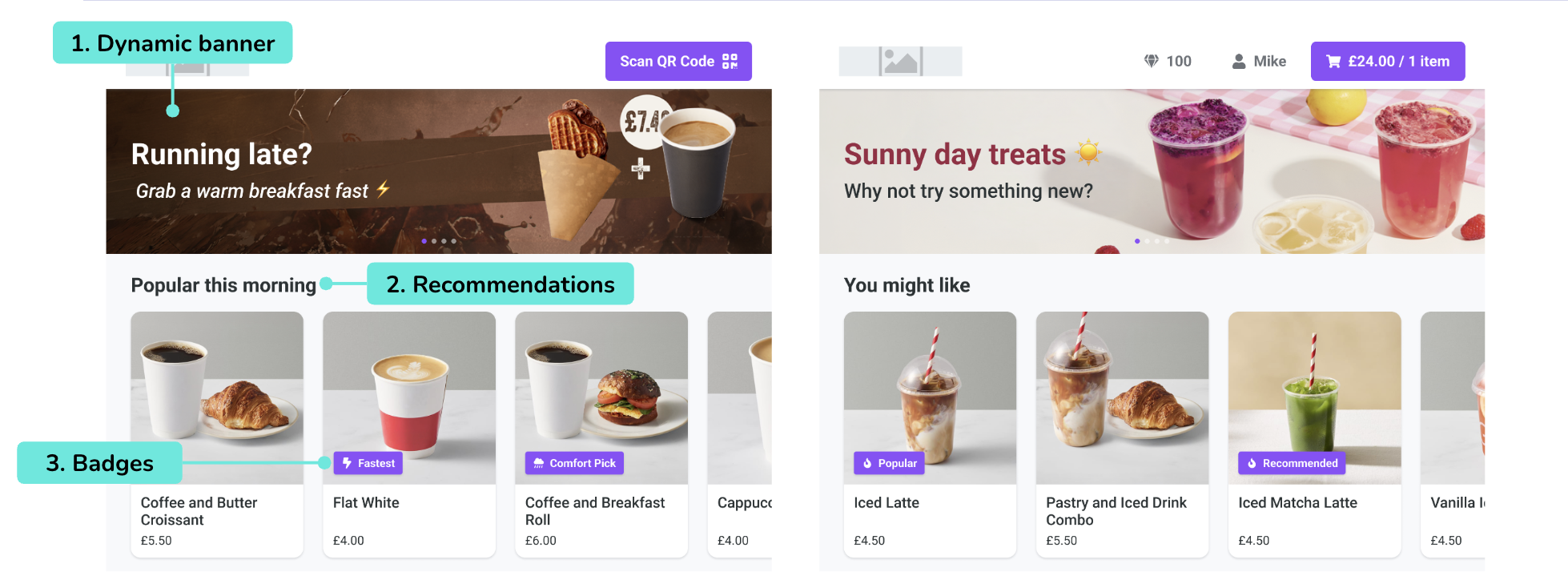
More control, less admin

Several efficiency improvements are in development: menu scheduling and a bulk menu editor to keep menus optimised for revenue, and a one-to-many printing capability that routes a single POS order via Near Field Communication (NFC) to multiple prep stations.

On the loyalty side, we’re improving the visibility of rewards across self-service kiosks, Click & Collect, and the mobile app, so guests can see exactly what rewards they have the moment they log in. Product tags will let operators nudge guests toward best-selling or higher-margin items.

Catering and payments

Catering functionality is coming, including business accounts, credit line workflows, and invoice enhancements. Payment improvements will give franchise businesses more control over payment flows.

Estate management and audit logs

Custom rules and permissions will give operators more granular control over the estate. Audit logs will show everything that’s changed, at the estate or individual store level, and when.

The principle behind what we build

Every release follows the same logic: put more control in your hands, reduce friction in your daily operations, and build systems that hold up as you scale.
Scout surfaces insights that used to take hours. VM Hub puts estate management in your hands without a support ticket. The offline capability means a lost internet connection no longer means a lost service.

Running multiple sites, managing complex menus, and coordinating across channels creates enough complexity on its own. The technology should reduce that, not add to it.

One platform for menus, channels, kitchens, and guest data.

Built for brands going from six sites to six hundred. Book a chat with us to find out more. 

Updated: 19 December 2025

Hospitality operators need systems that keep pace with their business and handle the busywork for them. Menu changes, can’t wait until Monday morning. Support tickets shouldn’t hold up your operations. Your technology should work for you, not the other way around.

Over the past two quarters, we’ve released features designed around three core principles: helping you improve efficiency, increase revenue, and give you peace of mind knowing your systems are stable.

Here’s what’s now available across our Restaurant Order Management System.

Improve efficiency

Self-serve menu push

Managing menus across multiple delivery aggregators should be simple, quick, and entirely managed by you.

Launched in October, our self-serve menu push feature enables you to update your third-party delivery menus at any time. You control the timing. Push to directly one aggregator, two, or all three at once. The choice is entirely in your hands, with no platform or person between.

Once you initiate a menu push, you’ll see the status of each update in real time. If something’s not quite right, you’ll get clear error messages that explain exactly what needs fixing.

The magic button is now in your hands.

Default menus per Point of Sale device

Different stations need different menus. A coffee-only counter shouldn’t need to display your whole menu. A breakfast shift shouldn’t show lunch items.

Restaurant Point of Sale (POS) users can now assign a default menu directly from their device. Switch between breakfast and lunch menus without manual intervention. Set one station to show your full offering while another displays only coffee items.

Fewer clicks per transaction means faster service. Simplified menus mean less confusion. Your staff spend less time navigating screens and more time serving customers.

Deliveroo Tabletless Integration

Control Deliveroo orders directly from the KDS and reduce in-store hardware with our improved tabletless integration.

See all upcoming orders and driver status from a single source of truth, directly from the Vita Mojo KDS. Let drivers know orders are ready to collect with a single tap on the KDS.

Increase revenue

Mobile App homepage improvements

Loyalty works best when customers can see their rewards. We’ve made rewards visible on your Mobile App homepage, so they’re impossible to miss.

Badges now notify users when they’ve earned new rewards or when existing rewards are about to expire. No more forgotten offers. No more missed opportunities to encourage repeat visits.

Making rewards front and centre drives usage. Usage drives transactions. Transactions drive revenue.

New analytics dashboards turning data into decisions

Understanding what guests buy, when they return, and what slows down your kitchen matters for growth. We’ve built three new dashboards that immediately turn your data into decisions.

  • Basket analysis shows what guests buy together. Spot and act on upsell opportunities. Build smarter menu structures. Increase average order value based on actual behaviour, not guesswork.
  • Cohort retention tracks how different groups of guests return over time. See which loyalty strategies actually work. Identify where you’re losing customers and fix it.
  • Product throughput reveals what drives volume and what creates bottlenecks. Speed up operations where it counts. Focus on offering menu items that deliver profitability.

All three dashboards are pre-built and ready to use. No configuration required. See what matters across every site in your estate with just one click of a button.

Peace of mind

Allergen visibility improvements

Finding and filtering by allergens across ordering channels needed to be smarter. We’ve enhanced the allergen filter logic and user experience to cover more scenarios, assuring both operators and guests peace of mind.

Guests can easily spot alternative customisations for items that include allergens by default, like dairy in a latte.
Meal and item-level allergen tags now appear on the POS. You can add this information to printed kitchen tickets, so no allergen goes unchecked between order and preparation.

These changes help you manage risk whilst giving your servers and guests the clarity they need to make informed decisions.

What else shipped

Beyond the major releases, we’ve delivered several additional features based on what our clients have been asking for:

  • Deliveroo loyalty linking connects your scheme with third-party delivery orders, converting and driving usage on Vita Mojo ordering channels
  • Buy one, get one free promotions give you more flexibility in how you reward customers
  • Cash management by employee and till provides better clarity and financial controls
  • Shared modifier groups make menu management easier and faster across multiple items
  • Kitchen Display System (KDS) counters enable you to efficiently track quantities in real-time
  • Service charge can now be applied after discounts for more accurate and profitable pricing

Looking ahead: VM Hub launching soon

The most significant update on the horizon is VM Hub, our unified platform that brings all your tools under one roof.

Currently, Vita Mojo has multiple faces. VM Hub consolidates everything into a single window. One login. No redirection. Complete control over your operations in one place.

Phase one includes self-serve tools for splash screen editing, menu push, and basket recommendations. You’ll see a history of all updates with the ability to restore previous versions. An embedded help widget will provide support exactly when you need it, tailored to whatever task you’re working on.

Phase two will add bulk menu editing and scheduling features. You can plan changes in advance and execute them without last-minute manual work.

VM Hub defines a shift in how you run your operations. The most control you’ve ever had. Do less and achieve more. Faster execution when your business needs to move quickly.

The pattern behind the releases

Every feature we’ve shipped follows the same logic: put more power in your hands, reduce friction in your daily operations, and build systems that stay stable as you scale.

Self-serve features cut support dependency by 90%. Analytics dashboards surface insights without requiring data science expertise. Resilience improvements happen invisibly but protect your operations constantly.

Running multiple sites, managing complex menus, and coordinating across channels creates enough challenges without your technology adding more. These releases aim to remove obstacles, not create new ones.

Your teams can now push menus when it suits them. Set up devices to run fast, seamless transactions. See exactly what’s happening with allergens and mitigate risk. Track what’s actually driving revenue. Make changes knowing you can reverse them if needed.

Technology should amplify what you do well, not dictate how you work. That’s the principle guiding what we build and why we build it.

Take Control
with Vita Mojo

Ready to simplify your restaurant operations and grow faster?